Slavic Witches, Sorcerers and Healers: What Belarusian Villages Believed
Witches who steal milk and knot curses into the rye, sorcerers given the seat of honour at weddings, and healers who whisper charms over water: the accomplices of the unholy, as Belarusian villagers ranked them in 1895.
In this post
A Slavic witch, in Belarusian village belief, was a woman or man in league with the devil himself: she stole milk from other people's cows, knotted curses into the rye and could change into a magpie or a black cat. She was the most hated of the people villagers called accomplices of the unholy, but not the only one. Beside her stood the sorcerer, feared and flattered, and the healer, who drew on much of the same lore and was honoured for it.
That ranking comes from Adam Bahdanovich's Remnants of the Ancient Worldview among Belarusians (1895), now in its first English translation. Bahdanovich, an ethnographer, recorded the beliefs of central Belarus himself, most of his charms from a single family of healers, and gave a whole chapter to the "Accomplices of the Unholy". The unholy, in Belarusian belief, is the collective name for devils, imps and evil spirits of every kind, and for the power witches and sorcerers draw on. For the spirits themselves, see our field guide to Slavic folklore creatures.
Accomplices of the unholy: who was who in a Belarusian village
In any part of Belarus, Bahdanovich writes, people would point out men and women who kept company with the devil and had sold him their souls. They went by several names:
- Charovnik and charovnitsa: a sorcerer, male and female, someone who can work chary, enchantments.
- Znakhar and znakharka: a healer.
- Vorozhbit and vorozhbitka: a fortune-teller.
- Vedzmak and vedzma: a male and a female witch.
- Vaukalak: a werewolf, a person who turns into a wolf.
In old East Slavic writings, such names meant people of higher knowledge, who knew the sacred incantations, foretold the future and healed the sick. By the 1890s villagers ranked them. It was worse to be a witch, male witch or werewolf than simply a sorcerer, and those three words were used as insults. Sorcerer, fortune-teller and healer were not. "To be known as a healer is even an honor."
What did Slavic witches do?
Witches had the worst name of all, Bahdanovich explains, because the witch was believed to be the devil's own mistress. From him she learned sorcery and the secret properties of herbs and roots. To the herbs she added a fox's heart and a cat's liver, recited her incantations and boiled them down into a potion that gave her youth and beauty, or an allure no mortal could resist.
The potion also made her light as down, so she could fly on the wind to the witches' sabbath on a high mountain, left bald by its contact with the unholy. The main sabbath came once a year, on the stormiest night between St Elijah's Day and the Dormition, in high summer. Nothing like the Black Mass of Western witch-trial lore survived in Belarusian memory.
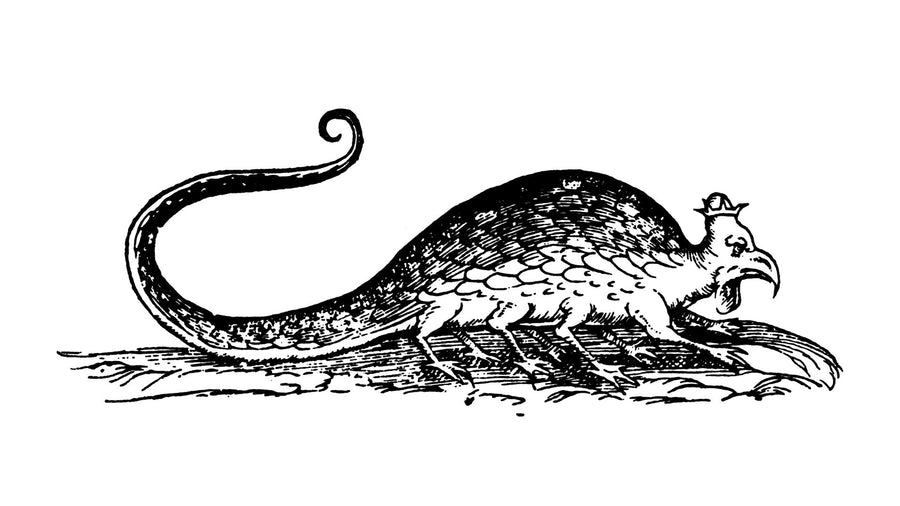
On earth, witches stole milk from other people's cows (hence vedzmy-karovnitsy, cow-witches) and twisted curses into the rye to bring crop failure, sickness and death. They could put the evil eye on a pregnant woman and cause a miscarriage, and steal infants from their mothers. "The witch can also turn into a magpie or a black cat."
Zalomy: the curse knotted into the rye
The most dangerous sorcery of all was the zalom: a knot or twist tied in standing rye, with a spell naming whose head it fell on, what he must suffer and how he must die. A family that found one in its field was terrified. No one would touch it, for fear their arm would wither, and a sorcerer was paid, fed and given drink to pull it out. If an educated man pulled one out and came to no harm, peasants explained that sorcery cannot hurt a literate man, or that he must know magic himself.
Kupala Night and the cow-witch
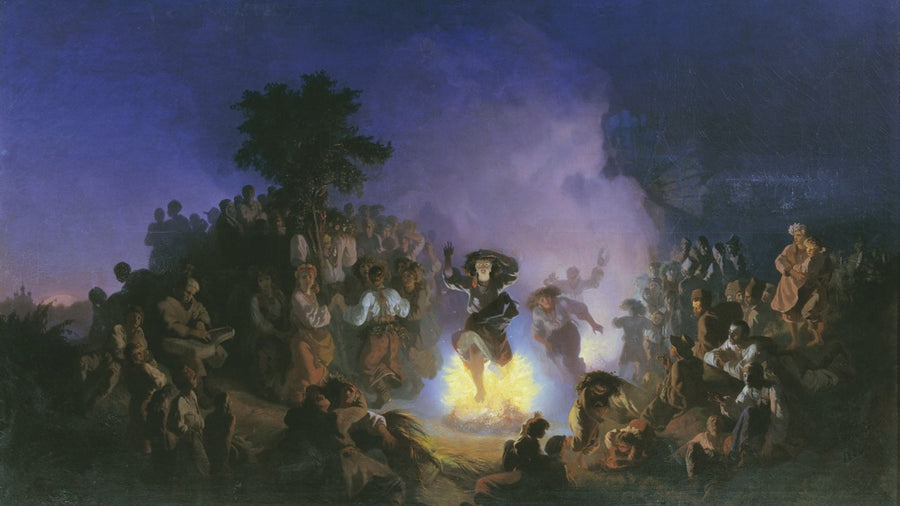
Kupalle, the midsummer night, was the cow-witch's night. She went round other people's gardens with a milk strainer, gathered the dew into a milking pail and gave it to her own cows, so the cows whose dew she took lost their milk. Careful housewives guarded their gardens all night, and cows were driven through a fire laid at the gate. If the milk was taken anyway, a strainer boiled in Kupalle herbs made the witch waste away, unless someone lent her something within three days. Even the Kupalle bonfire song says the fires are lit so that witches might not twist zalomy or take the milk. More on that night in Kupala Night: fern flowers, witches and bonfires.
Sorcerers: from the miller to the man who sold his soul
Most sorcerers, Bahdanovich found, were specialists whose trade put them in touch with one unholy power. A miller who could not keep the water spirit happy was a poor miller, so at the first frost he lowered a piece of salt pork under the wheel. A forester bought off the forest spirit with bread and his own hair, and a herdsman had to drive the barn spirit out of the stable. Few villagers thought this wrong: it was the higher knowledge of the trade.
A true sorcerer was another matter. To gain full power he had to sell his soul: break with the church, keep the Communion in his mouth instead of swallowing it, carry it to a wayside cross at a crossroads and fire a gun at it. From then on the devil served him until he died, and whatever he said came true. Bahdanovich doubted anyone had dared it since ancient times, but stories of those who had, and went mad, were everywhere.
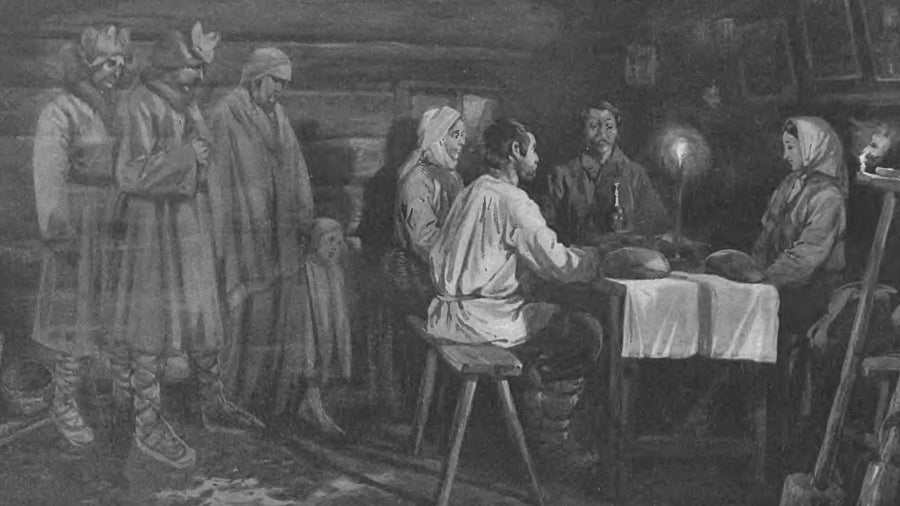
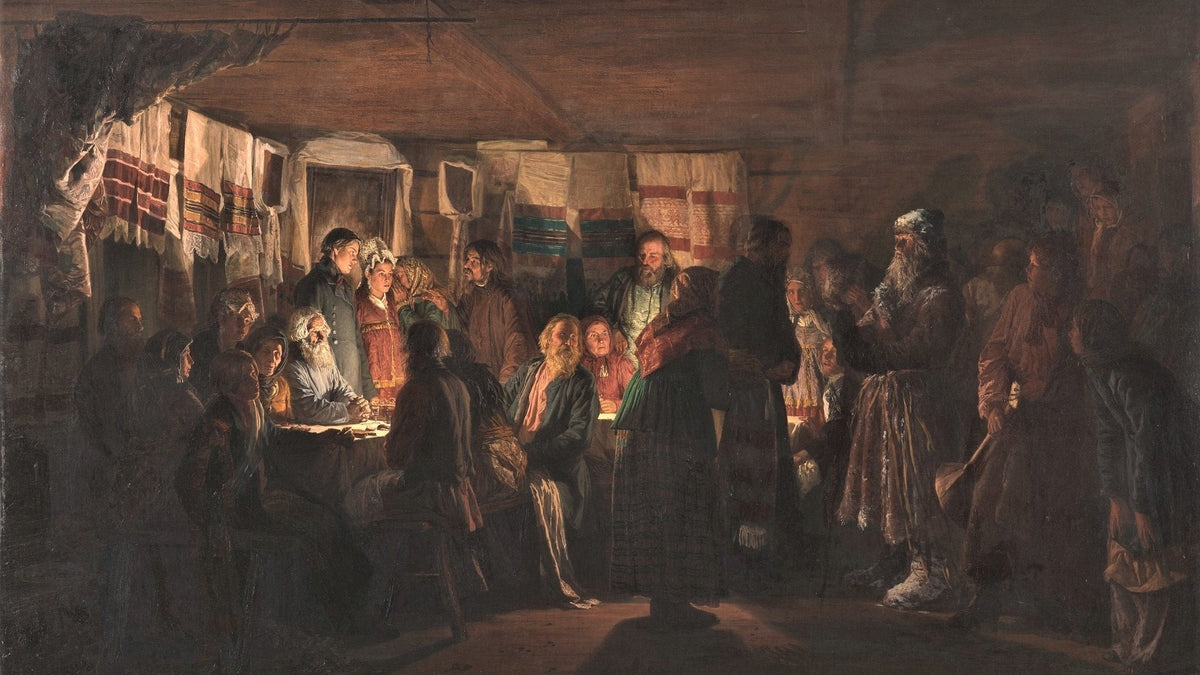
Such men were treated with outward respect. At weddings and christenings they got the seats of honour and the best food and drink, so they would not harm the newlyweds or the baby. When the urge to bewitch came over a sorcerer, villagers said, the unholy power rushed into his head, and it was best to keep out of his sight. At the end, a sorcerer's soul refused to leave his body, and demons had to tear it out with hooks.
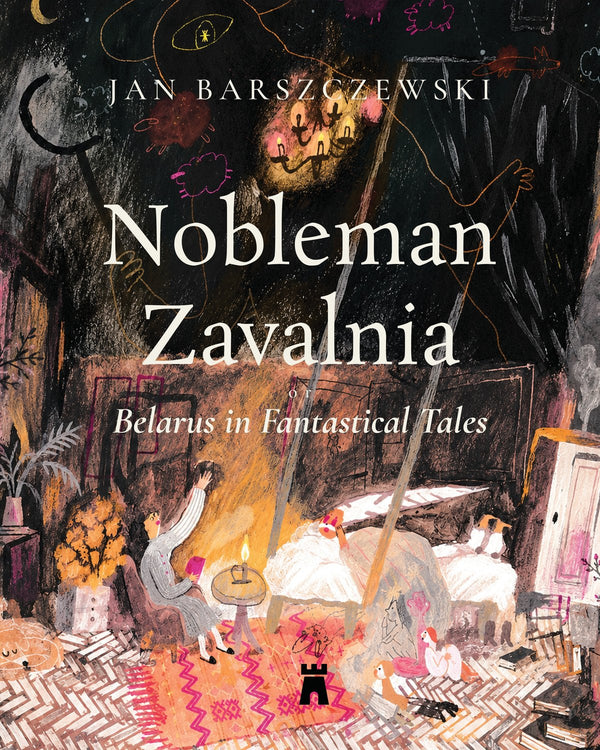
Barszczewski puts exactly such a man at a wedding in the first tale of Nobleman Zavalnia: Paramon, seated in the place of honour, who punishes two mocking guests by making them play and dance until they drop. His story is in The Dragon Hatched from a Rooster's Egg.
Healers and fortune-tellers: the znakharka
Women healers far outnumbered men, and those who kept to curing disease and undoing other people's sorcery were sincerely honoured. Their commonest cure was dats vady, giving water: the healer took a mug of water into the yard at sunrise and whispered a charm over it facing east, then south, then west, and the patient drank it or bathed in it. Their charms mix the oldest images, age-old oaks, wonder-working water, the sun and the storm cloud, with the Mother of God and the saints. Families kept them secret. Asked for their charms, healers usually said they knew nothing beyond how to cross themselves.
They had practical skills too: they set dislocations, splinted broken bones with bast and clay, and treated fever with wormwood.
There was a famous fortune-teller in Bahdanovich's own family, and a healer too. On holidays her house was packed. She believed in her craft completely, kept every rite of the church and did the penances the priests set her for fortune-telling, yet could not give up healing. She would not tell fortunes on Wednesdays, Fridays or fast days, though she still gave the sick her water and potions. When, near death, she offered to teach her daughters, not one of them dared to learn.
Witch trials in Belarus
These beliefs cost lives. Belarus never had a formal Inquisition, and witches were not burned on the Western European scale, but Bahdanovich prints a letter from the mid-eighteenth century, written by the steward of Count Tyszkiewicz's estate to his lord: "I have burned six charovnitsy: three confessed, and the rest did not." The women had been kept under a vat for eleven days. A Mr. Epernetti, he adds, has burned a woman and a man.
Bahdanovich blamed ignorance, and serfdom, which bore hardest on women, bound both to their husbands and to the landowner. On that soil, he argued, nervous illnesses spread, and some sufferers truly believed they were in league with the devil.
Healer or witch? Aryna's story in Nobleman Zavalnia
Jan Barszczewski's tales in Nobleman Zavalnia, published half a century before Bahdanovich and independently of him, show the same beliefs at work in northern Belarus. The clearest case is Aryna, a widow in the second tale, "Daring Deeds".
In a village tavern a drunk lad, Maksim, taunts young Vasyl, who is to marry Aryna's daughter, by telling everyone why Aryna limps. One evening, he says, a villager named Gryshka heard a witch's voice calling the village cows by their colours, and the cows lowing back. He found Aryna on a fence, hair wild, casting spells. He put consecrated herbs and a wax candle over his barn door, but a magpie swooped down, scattered the herbs and pecked at the candle. He fired small shot at it. Next day Aryna was in bed with an injured left leg. Later she knotted a zalom in his rye, which he burned over aspen wood.
A brawl breaks out. The tavern keeper tells the steward a different story: Aryna helps a great many people with her herbs. He watched her cure a young lady's rash by dropping pebbles into cold water and whispering until the water boiled. Aryna herself comes to the manor in tears. She has never harmed anyone, she says; she only cures with herbs whose power is known to her alone. The master dismisses the gossip and promises to hold her daughter's wedding at the manor.
Bahdanovich's whole ranking is in that one woman: the healer who gives water and the cow-witch who flies as a magpie, depending on who is telling the tale.
His other witches follow the folk script as closely. In "The Werewolf", the forest witch Aksinia flees as a cat, turns into a magpie and lands on her roof as a cat again. In "The White Magpie" a witch-lady arrives as a snow-white bird, and after her visits a witch steals the cows' milk on Kupalle night and breaks appear in the rye: the two crimes Bahdanovich pairs. Who she really was is a story of its own: the White Magpie's tale.