Belarusian Literature in English: Where to Start
A translator's starting list of eleven Belarusian books in English, from Maksim Haretski's 1919 novel Two Souls to Alexievich, Bykau, Karatkevich and writers working today.
In this post
Belarusian literature in English is a small corner of translated literature, and the best way in is through a handful of books. Start with Maksim Haretski's 1919 novel Two Souls, Svetlana Alexievich's oral histories, Vasil Bykau's war novels and Uladzimir Karatkevich's gothic King Stakh's Wild Hunt. Then move on to living writers such as Alhierd Bacharevič and Valzhyna Mort. Below is a starting list of eleven books.
I translate from Belarusian and Russian into English, and four of these books are Grunwald titles, so I've put them first and kept them clearly separate. If you want just one book to begin with, my answer is Haretski's novel Two Souls in English: a short book about a man split down the middle by the Russian Revolution.
A short history of Belarusian literature
Belarusian writing is old, but its modern literature is young. For centuries most Belarusian lands belonged to the Grand Duchy of Lithuania, whose chancery language, Ruthenian, is the ancestor of modern Belarusian; the Duchy's 1588 Statute was written in it. After the partitions of the Polish–Lithuanian Commonwealth in the late 18th century, the region passed to the Russian Empire, and for most of the 19th century educated people wrote about Belarus in Polish or Russian.
The modern literature took shape in the newspaper Nasha Niva (1906–1915). It launched the two national poets, Yanka Kupala (Янка Купала) and Yakub Kolas (Якуб Колас), and the lyric poet Maksim Bahdanovich, who died in 1917 at the age of 25. Soviet "Belarusization" in the 1920s brought a short flowering, and the 1930s destroyed it. In a single night in October 1937, more than a hundred members of the Belarusian intelligentsia were shot in Minsk, over twenty of them writers. Haretski was executed in 1938.
After the Second World War, Vasil Bykau wrote some of the most unflinching fiction about that war, and Uladzimir Karatkevich brought history and romance back into Belarusian prose. Today the literature is written in two languages: Belarusian and Russian, which dominates daily life in Belarusian cities. Since the crackdown that followed the 2020 presidential election, many Belarusian writers have worked in exile.
Where to start: four books from Grunwald
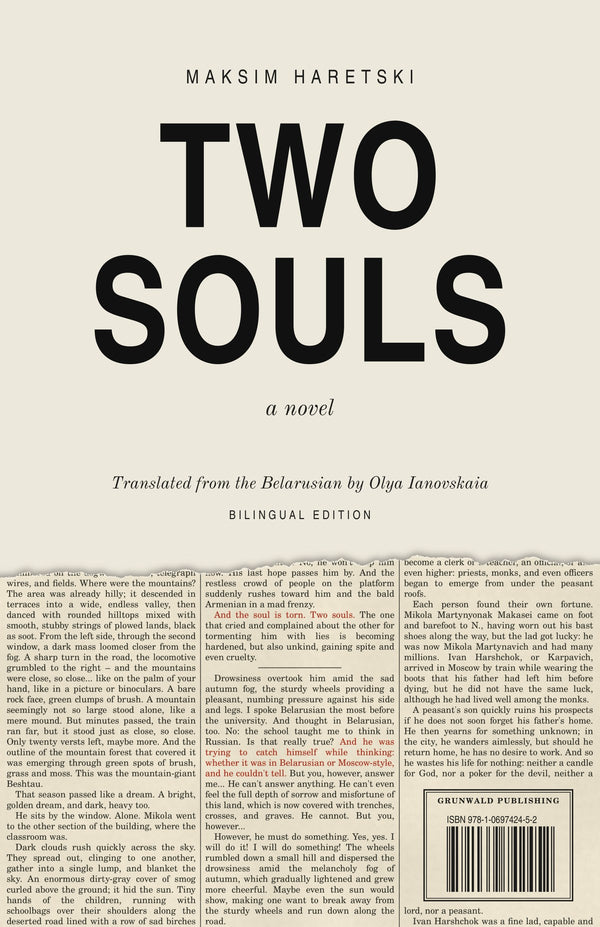
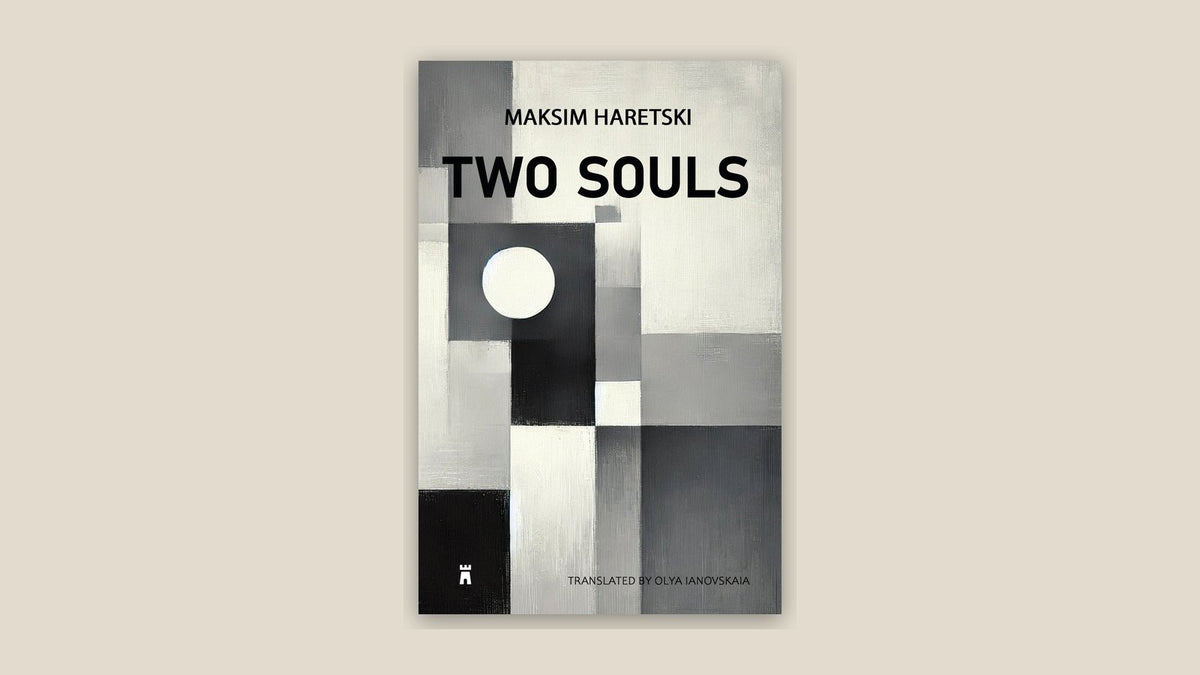
1. Two Souls by Maksim Haretski (1919)
Two Souls (Дзьве душы) is where I'd send any new reader first. Ignat Abdziralovich is heir to the Krupki estate and grew up alongside Vasil, his wet nurse's son. In 1917 he is a convalescent army officer drifting between Moscow and the Caucasus. He loves a millionaire's daughter, who turns to a prince. When a young Belarusian activist on a country road asks him what he is doing for his homeland, he laughs: "my Fatherland is all of Russia." The rest of the novel takes that answer apart.
Haretski gives his hero's divided loyalties a literal shape. When a curt letter from the girl's mother ends the romance, "his soul was torn into two." Later, in the street fighting in Moscow, one half of him understands the Whites and the other half the Reds. A deathbed confession then turns the question of who Ignat is into something deeper than politics. The novel's own young nationalists argue about him: one of them dismisses the "two souls" as plain spinelessness.
Haretski is known as the first Belarusian existentialist writer, and Two Souls belongs on any shelf of existentialist novels. It was first published in Vilnia in 1919, and its critique of Bolshevism kept it suppressed for decades. The philosopher Ignat Kancheuski even published his 1921 essay on Belarusian philosophy under the hero's name. BlueInk Review's starred review called Two Souls "Highly recommended for fans of Franz Kafka and Albert Camus."
It is also a snapshot of its literary moment. In chapter XV, two young revivalists walking through the wheat argue over whether Kolas or Kupala is the better poet ("And I like both of them," says the teacher who overhears them). Then one of them recites Bahdanovich and an elegy for him. Learners can read it next to Haretski's original in the bilingual flip-book edition, Two Souls / Дзьве душы (C$27.99), which prints the Belarusian in its 1919 Vilnia spelling.
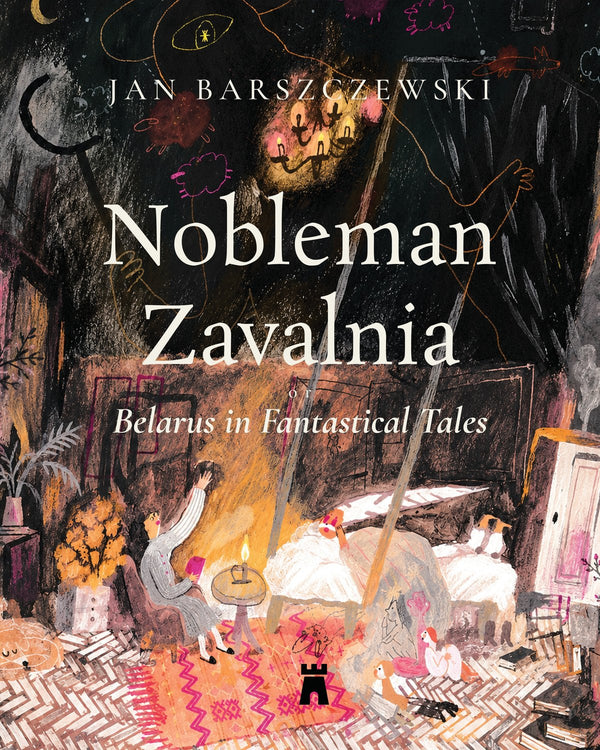
2. Nobleman Zavalnia, or Belarus in Fantastical Tales by Jan Barszczewski (1846)
Belarusian folk horror before anyone had the word. Barszczewski wrote in Polish, but his tales come from the legends of the Polatsk region and are told at a Belarusian nobleman's hearth by peasants, nobles and wanderers. They are full of witches, restless souls, enchanted forests and haunted battlefields, and set in 1816–1817, the time of the "year without a summer." Haretski himself translated several of the tales into Belarusian. My English translation, made from the Belarusian, is out as a trade paperback (C$27.99, few copies left) and an EPUB (C$10.99), and as a full-colour illustrated hardcover with art by Nasta Lee (C$60, pre-order, shipping late December 2026 to early January 2027). Compare it with Gogol in If You Loved Gogol's Dikanka, Read Barszczewski.
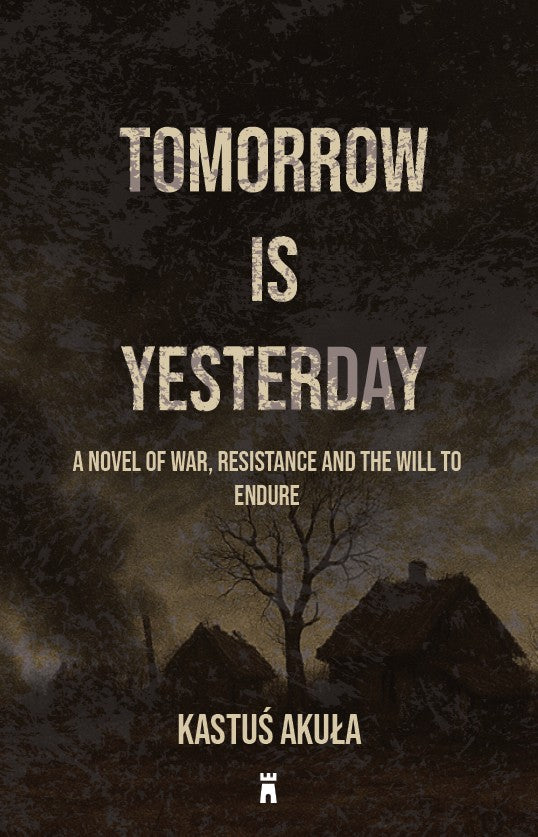
3. Tomorrow is Yesterday by Kastuś Akuła (1968)
A Belarusian novel written in English, in Canada. Akuła (born 1925) lived through the German occupation of Belarus and settled in Canada in 1947. His novel follows Mary Karaway, a young widowed teacher in a village near Haradok, in the Vitsebsk region, caught between Soviet and German occupiers. One act of kindness sets off consequences that reach all the way to Toronto. Grunwald reissued Tomorrow is Yesterday, Akuła's English-language war novel for his centenary, in paperback from C$21.99.
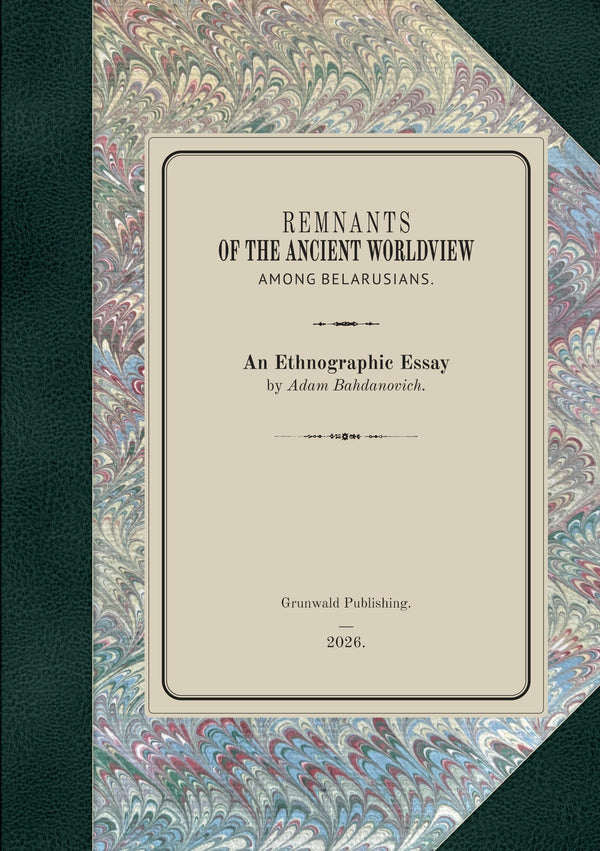
4. Remnants of the Ancient Worldview among Belarusians by Adam Bahdanovich (1895)
Not fiction, but the best key I know to the folklore beneath Belarusian fiction. Adam Bahdanovich, father of the poet Maksim, tried to set out the folk beliefs of the Belarusians as a single system: house and forest spirits, the sun cult, witches, sorcerers, healers and their charms. I edited its first English translation, made from the Russian. For a taste of the beings it describes, see our field guide to Slavic folklore creatures.
Seven more Belarusian books in English
5. Like Water, Like Fire, translated by Vera Rich (1971)
The classic English anthology of Belarusian poetry from 1828 to its own day, published in London in UNESCO's series of representative works. Kupala, Kolas and Bahdanovich are at its heart, and the title comes from a Kupala poem. Out of print; try libraries and second-hand shops.
6. King Stakh's Wild Hunt by Uladzimir Karatkevich (1964)
A young folklorist lost on the marshes takes shelter in a cursed castle, where phantom riders of the Wild Hunt close in. Translated by Mary Mintz (Glagoslav).
7. Alpine Ballad by Vasil Bykau (1964)
Bykau (1924–2003) wrote in Belarusian, but most older English versions were made from Russian ones. Mikalai Khilo's 2016 translation of Alpine Ballad (Glagoslav) is the first uncensored one made straight from the Belarusian. Bykau's The Ordeal (Sotnikaŭ, 1970) was the basis for Larisa Shepitko's film The Ascent.
8. The Unwomanly Face of War and Secondhand Time by Svetlana Alexievich
The best-known Belarusian writer in the world, and the 2015 Nobel laureate, writes in Russian. Alexievich builds her books from interviews. The Unwomanly Face of War (translated by Richard Pevear and Larissa Volokhonsky) gathers Soviet women who served in the Second World War. Secondhand Time (translated by Bela Shayevich) records people living through the Soviet collapse. Her other books in English are Voices from Chernobyl (Chernobyl Prayer in the UK), Last Witnesses and Boys in Zinc (Zinky Boys in the US).
9. Alindarka's Children by Alhierd Bacharevič (2014)
A brother and sister escape a camp where children are made to forget Belarusian, in a dark retelling of Hansel and Gretel. Jim Dingley and Petra Reid translate the Russian into English and the Belarusian into Scots, so the book's language politics stay audible (Scotland Street Press; New Directions in the US).
10. Music for the Dead and Resurrected by Valzhyna Mort (2020)
Poems Mort drafted in both English and Belarusian, rooted in her birth country and its wounds and silences. It won the 2021 Griffin Poetry Prize (Farrar, Straus and Giroux).
11. Red Crosses by Sasha Filipenko (2017)
An old woman with Alzheimer's tells her young neighbour the story of her life, which runs through the whole Soviet century. Written in Russian; translated by Brian James Baer and Ellen Vayner (Europa Editions).
Which Belarusian book should you read first?
- Novels of ideas: Two Souls, then Bykau.
- Folklore and the gothic: Nobleman Zavalnia, then Karatkevich and Remnants.
- Non-fiction: Alexievich's The Unwomanly Face of War.
- Writers working now: Bacharevič, Mort and Filipenko.