Dziady: When the Dead Come Home to Supper
Dziady is the Belarusian day of the dead, when a family lays a memorial supper and invites its ancestors home. When it falls, how villages kept it in the 1890s, and what it means today.
In this post
Dziady (Дзяды, "grandfathers" or "forefathers") is the Belarusian day of the dead: the evening when a family cooks a memorial supper and invites the souls of its ancestors home to share it. The best-known Dziady falls in autumn, around the start of November, but the old village year had several, including spring Radaŭnica, when the meal is carried to the graves.
Dziady is not a carnival. It is quiet, domestic and a little uncanny: a scrubbed house, a white cloth, a candle before the icons and a door opened to guests nobody can see. It belongs to the world of the house spirits and werewolves in our field guide to Slavic folklore creatures, but on Dziady the visitors are family.
The fullest account of how villages kept Dziady comes from the ethnographer Adam Bahdanovich, who recorded the supper, the meal at the graves and the beliefs behind them in the 1890s. His chapter on the dead is in Grunwald's English edition of Remnants of the Ancient Worldview among Belarusians, the book's first English translation.
What does "Dziady" mean?
The word is the plural of dzied, grandfather, and stands for all of a family's forefathers. Bahdanovich pairs the dziady with the baby, the "grandmothers", and explains that the memorial tables held for them several times a year are themselves called Dziady. One word names the guests, the meal and the day: people "keep Dziady" (dzeduyuts) for the dziady.
When is Dziady? The Dziady of the year
Bahdanovich lists four Dziady in the Belarusian year. His dates follow the Julian (Old Style) church calendar then in use in the Russian Empire; the last column gives the next date in the ordinary calendar.
| Dziady | When it falls | Next date |
|---|---|---|
| Autumn Dziady, Dzmitraŭskaja subota (Дзмітраўская субота) | "Saint Demetrius's Dziady" in late October, Old Style; today the Saturday before St Demetrius's day (8 November) | 7 November 2026 |
| Dziady before Lent | The Saturday before Meatfare Sunday, just ahead of Maslenitsa week | 6 March 2027 |
| Radaŭnica (Радаўніца) | The Tuesday of St Thomas Week, nine days after Orthodox Easter | 11 May 2027 |
| Trinity Dziady | The eve of Trinity (Orthodox Pentecost) | 19 June 2027 |
Catholic Belarusians, like their Polish neighbours, remember the dead on All Souls' Day, 2 November (in Polish, Zaduszki), and many families now keep Dziady in early November, whatever their church. Radaŭnica is still a public holiday in Belarus.
How is Dziady kept? The supper for the ancestors
Bahdanovich's description reads like stage directions:
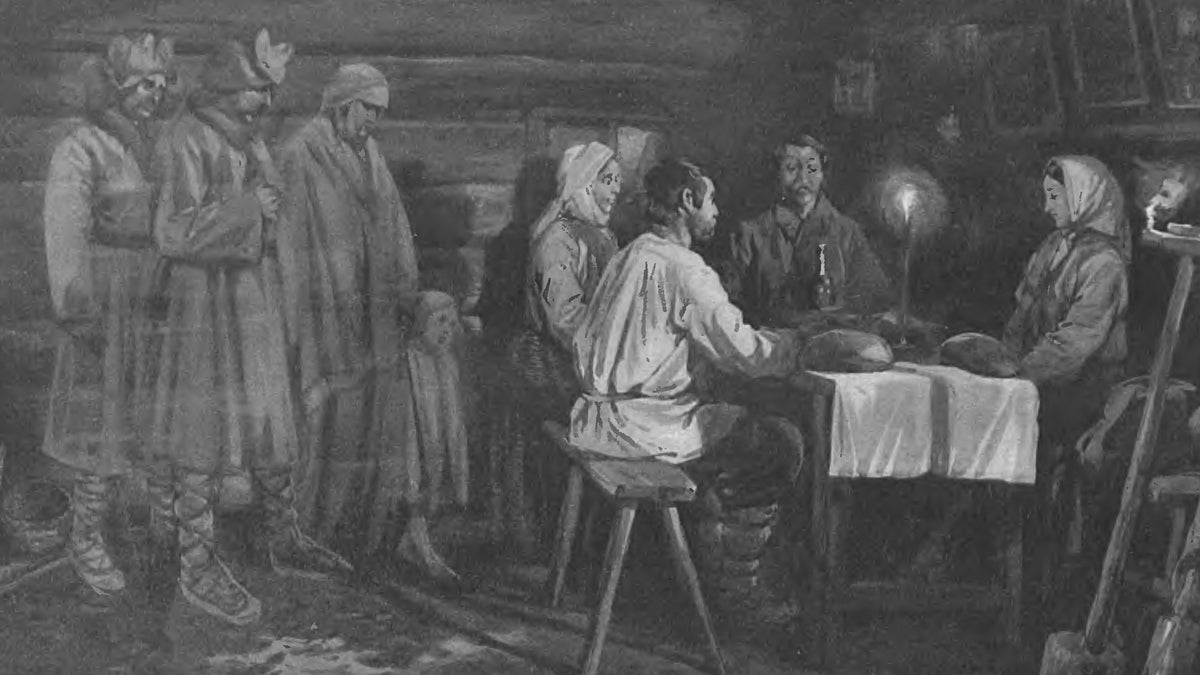
- The house is cleaned "as if expecting dear guests".
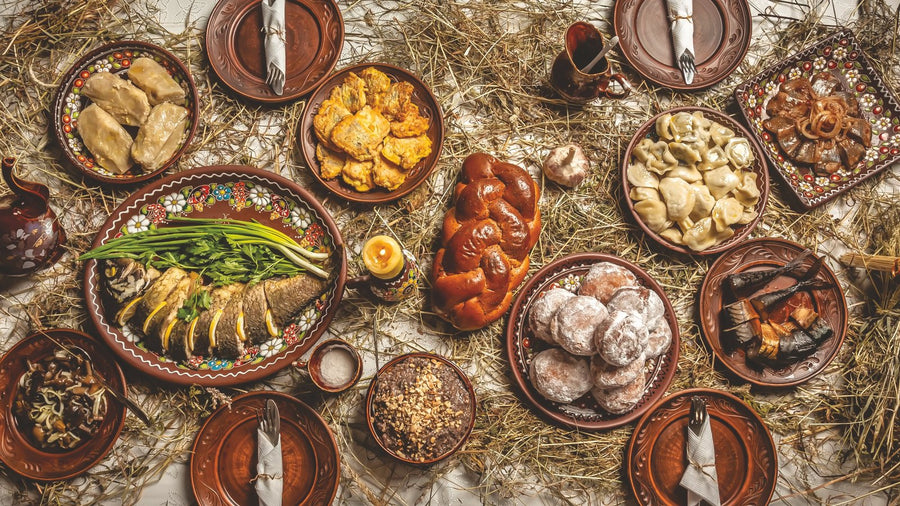
- Late in the evening the table is covered with a white cloth. Bread and salt are laid on it with a bowl of kuttsia (Bahdanovich's translation spells it kutiya), the boiled grain with honey eaten at funerals, commemorations and on Christmas Eve.
- A candle is lit before the icons and everyone prays for the dead.
- The master of the house steps outside the door and invites the dziady in to share the meal, which runs to as many as seven dishes.
- The family eats pokladayuchisia: each person swallows a spoonful, then lays the spoon down so that the dziady can take theirs.
- Because there may be more ancestors than spoons, a little of every dish is set aside on the windowsills and under the table.
It is customary not to clear anything from the table after this supper, so that the dziady will have something to eat when they gather in the night.
Talk turns to the dead, and coincidences become messages: a bird landing on the windowsill is taken for the soul of a relative who wants something from the family. Old people who already keep their burial shirt may take it as a summons. "That was so-and-so," they say, "who came for me". In Lepel district Bahdanovich also found Baby, "the Grandmothers", kept on the eve of Dziady with fewer dishes.
Radaŭnica: the spring Dziady at the graves
Belarusians believed that in spring, as nature wakes, the souls of the dead revive too and leave their coffins for the wide world. Radaŭnica (Russian Radonitsa), "the Great Day of the departed", differs from the other Dziady in one respect: the memorial meal is always held at the graves.
Housewives baked hribki ("little mushrooms"), thick wheat pancakes made with butter and eggs, and tied them up in a tablecloth with vodka, Easter cakes, eggs, cheese and butter. At the cemetery the tidied grave was covered with the cloth and the food laid out on it. What was not eaten stayed on the grave; vodka was poured on it if the dead man had liked a drink, and tobacco sprinkled if he smoked. Some families gave the leftovers to beggars and left only an Easter egg.
Why feed the dead?
The logic is simple. If death is a long sleep, the dead keep the needs of the living. The soul, pictured as a vapour, stays in its village for forty days, six of them around the house and three in its own gardens and fields, before it leaves for the other world. Each stage is marked by a memorial table: on the day of the burial, on the sixth, ninth and fortieth days, and on the anniversary, always with kuttsia, dumplings and bliny. Relatives who neglect this duty, the belief went, risk the vengeance of the dead. Dziady extends that care to every generation: the dead need food only three or four times a year.
Bahdanovich also records a tale that pushes back against all this feeding. A dead man finds an empty table in the other world, goes home for provisions, has them piled into his grave and refuses alms to every beggar on the way. Only one pie, dropped in the mud and given away out of embarrassment, is on his table when he returns. The surest gift to the dead, this "loftier view" held, was charity to the living.
Forefathers' Eve, All Souls' Day and the "Slavic Halloween"
English readers often meet Dziady as Forefathers' Eve, the English title of Adam Mickiewicz's verse drama Dziady. Mickiewicz grew up in Navahrudak, in what is now western Belarus, and Part II of the drama (published with Part IV in Vilnius in 1823) stages the rite itself: country people gathered by night in a chapel near a cemetery summon the souls of the dead. In his preface he describes Dziady as a rite still kept by common people in many districts of Lithuania, Prussia and Courland; his "Lithuania" was the former Grand Duchy, which took in the Navahrudak country. Some seventy years later Bahdanovich gathered part of his own material in the same Navahrudak district.
Dziady sits beside the Catholic All Souls' Day and the Polish Zaduszki, and its date, so close to 31 October, has earned it the nickname "Slavic Halloween". The likeness is mainly in the calendar. Halloween is a night of costumes; Dziady is a family supper at which the dead are the guests. If you are looking for a Slavic day of the dead, this is it.
Dziady and Kurapaty: a day of remembrance since 1988
Since 1988, Dziady in Belarus has also been a day to remember the victims of Stalin's terror. That June, Zianon Pazniak and Jauhien Šmyhaloŭ published "Kurapaty: The Road of Death", about the forest on the edge of Minsk where the NKVD shot people in 1937–1941. On 30 October 1988 a Dziady procession set out for Kurapaty to honour the dead, and the police broke it up with tear gas and water cannon. Since then, for many Belarusians, Dziady has honoured both their ancestors and the victims of Kurapaty and other execution sites.
Keeping Dziady today
You do not need a village to keep Dziady. Clean the house, lay a white cloth with bread, salt and kuttsia, light a candle, tell the stories of the people you have lost, and leave a little food out overnight.
Kuttsia also anchors the Christmas Eve supper, and Bahdanovich lays the two tables alike: bread, salt, kuttsia and, at Christmas, no fewer than seven dishes. Read more in our guide to the Belarusian Christmas Eve supper and kuttsia. For the autumn table, The Belarusian Cookbook notes that roast leg of lamb was once cooked "especially for Dziady (All Souls' Day)", and gives two kuttsias.