Kupala Night (Kupalle): Fern Flowers, Witches and Bonfires
From the herb-gathering to the playing sun at dawn: Kupalle, the Belarusian midsummer night of fern flowers, treasure, dew-stealing witches and bonfires, as Bahdanovich recorded it and Barszczewski wrote it.
In this post
Kupala Night, Kupalle in Belarusian, is the Slavic midsummer festival: the night before the feast of St John the Baptist, 23–24 June in the old church calendar. It is the night the fern is said to bloom, treasures rise out of the ground, witches steal the dew, and young people dance round bonfires until sunrise. The Church joined it to the feast of St John, which is why it is also known as Ivan Kupala or St John's Eve.
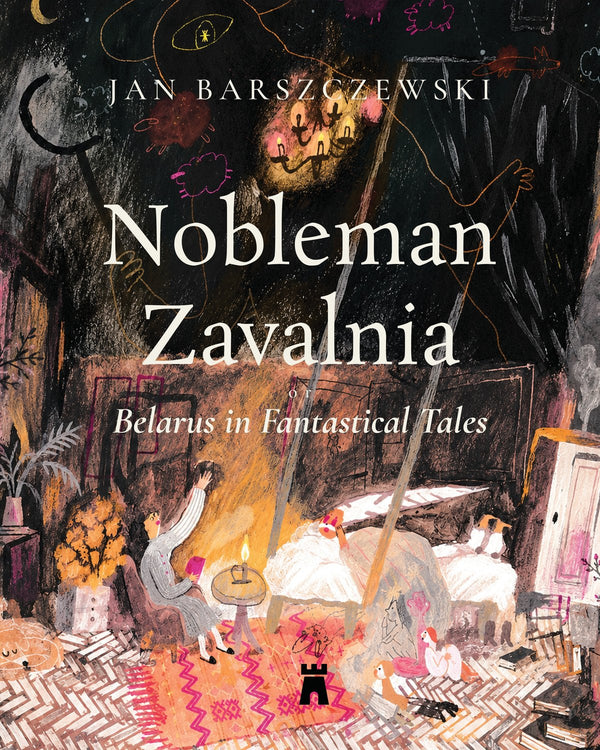
The Belarusian ethnographer Adam Bahdanovich, who recorded the festival in Belarusian villages, ranked it above all the others: “Perhaps no other folk festival preserves as many remnants of pagan antiquity as Kupalle”. His account, in Remnants of the Ancient Worldview among Belarusians (1895), now in English for the first time, follows Kupalle from the herb-gathering by day to the sunrise. Half a century earlier, Jan Barszczewski described the same night in Nobleman Zavalnia (1846) and set one of his witches to work in it. For the spirits and witches abroad that night, see our field guide to Slavic folklore creatures.
When is Kupala Night?
By the Julian calendar, the old church calendar Bahdanovich used, Kupalle falls on the night of 23 to 24 June. Belarus now keeps it on the night of 6 to 7 July, which is the same date in the old reckoning.
Bahdanovich counted it among the old festivals of the sun: Kaliady (the midwinter festival) for the winter sun, Kupalle for the summer sun. Unlike Dziady, the feast of the dead, which each family keeps at home, Kupalle was celebrated by everyone together, in a crowd.
Gathering Kupalle herbs
The day belongs to the herbs. Herbs and flowers picked on Kupalle were believed to gain special healing or magical power, so girls and married women fanned out across the fields and meadows to gather them, and took them to church the next day to be blessed. Through the year they served as medicine.
The most prized was the kupalka, the Kupalle flower. Bahdanovich could not give its botanical name; he describes white, fluffy flowers like willow catkins that open in the sun like dandelions. A kupalka was tucked behind the icons: if it had opened by the next day, a wish would come true. On Kupalle night, people said, the plants talk to one another, pay each other visits and even dance, though ordinary eyes cannot see it.
The fern flower legend
The great prize of the night is the fern flower. The fern, Bahdanovich writes, blooms only on Kupalle night, for a single instant, and its flowers burn like tiny sparks. The unholy powers put every obstacle in the way of anyone who seeks it: they deceive the eyes and, above all, terrify. Not every sorcerer is equal to the task, and most of those who go into the forest for the flower die of fright.
Whoever owns the flower gains the gift of knowing everything: above all, where treasure lies, what spell guards it and how to break the spell. So the unholy ones who guard the treasures try with all their might to take it away.
The Kupalle old man
Only one figure gathers the fern flowers without hindrance: the Kupalle old man, Kupalski dzedok. He walks about with a basket and fills it until the basket glows like embers. He is kind. If you meet him and spread a white tablecloth before him, he will throw one flower onto it. Snatch it up quickly, cut open the palm of your right hand and put the flower under the skin, where nothing unholy can get it out.
Treasure on Kupala Night
At Kupalle, treasures rise from under the ground to bathe and dry themselves, appearing as fire or glowing embers that vanish when anyone comes near. To take one, you must know the spell laid on it. One man buried his money with a spell that whoever laid down a head could have it. His son-in-law, who had been spying, noticed that the spell did not say whose head, cut off a rooster's head on the spot and took the money.
Witches and dew on Kupala Night
Kupalle is also the night when the cow-witches take the milk. A witch goes round other people's gardens with a milk strainer, gathers the dew into a milking pail, gives it to her own cows to drink and washes their udders with it. The cows of every household whose dew she has gathered lose their milk, or it turns thin and loses its cream, while her own cows give milk so thick it turns to butter in the pail.
Dew, villagers explained to Bahdanovich, is the sap of the earth, and at Kupalle it is milky. So careful housewives sat up all night guarding their gardens. At the gate, a fire was laid and the cows were driven through it. If the milk was stolen anyway, a strainer was boiled in Kupalle herbs and the brew given to the cows, and the witch who had taken the milk was supposed to waste away, unless someone lent her something within three days. For more on these women and their remedies, see Slavic witches, sorcerers and healers.
Kupala Night bonfires and the burning wheel
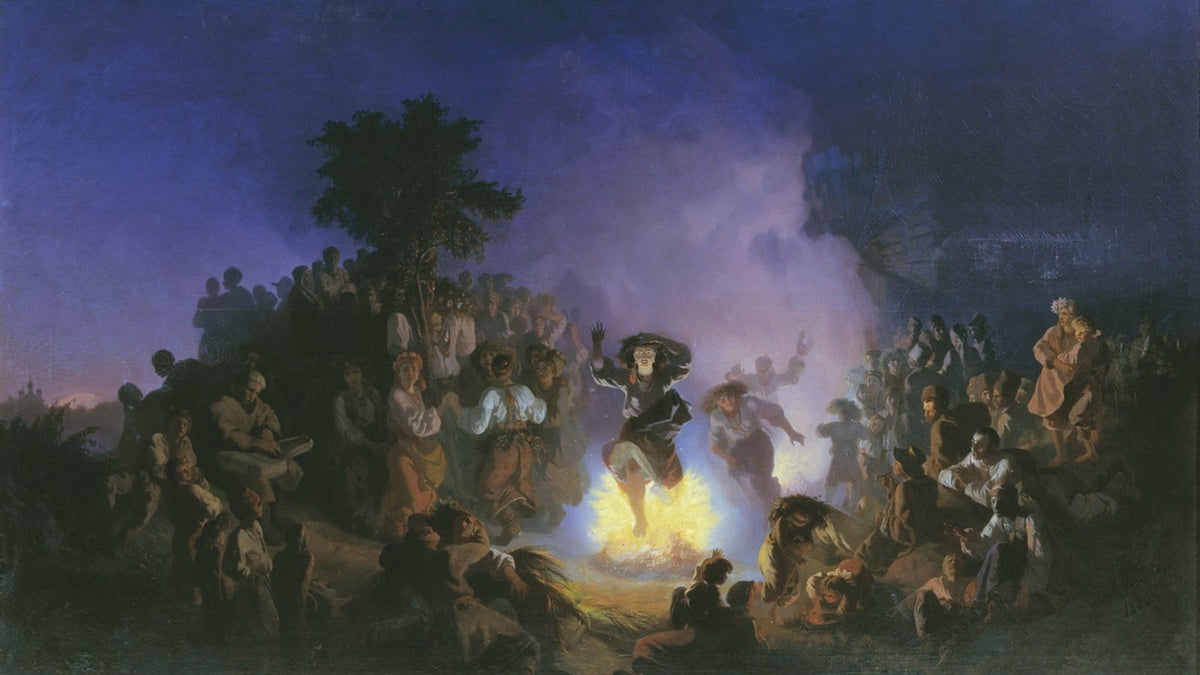
Above all, Kupalle is a festival of fire. The young men and women gathered in a clearing in the rye field and built a fire. They brought vodka bought with pooled money, the girls fried the eggs they had brought, and everyone ate around the fire. Then they set fire to an old wheel soaked in tar and mounted on a pole, so that it burned high in the air, and when one wheel burned out they lit another. Holding hands, they danced round it singing Kupalle songs, kupalki.
The first song is sung to the sun. It tells how the sun rose early, woke the girls and the lads and sent them to the field, with a task for the lads:
So that the lads might light the fires,
Light up the field, keep watch over the rye,
So that witches might not twist zalomy,
Might not take the milk from the cows.
Zalomy are knots twisted into standing rye: a witch's curse, meant to bring crop failure, sickness and death on people and cattle. After the song, the lads and girls jumped over the fire, in couples or alone, to cleanse themselves and guard against sickness, spoiling and spells.
Kupalle songs, wreaths and couples
The rest of the night, Bahdanovich thought, kept traces of an old cult of love. In Barysau district girls in wreaths of flowers and rye formed a round dance with the lads. A betrothed girl covered her face with a linen veil and, as the Kupalle girl, chose a partner, who tied her veil on his arm as at a wedding. When the bonfires died down, the couples slipped away into the rye to greet the sunrise. It may once have been a festival of free love, Bahdanovich allows, but in his day it was a rite, and village opinion kept the young in check.
Kupala Night in Nobleman Zavalnia
Barszczewski grew up near Polatsk in northern Belarus, and he describes Kupalle in the sketch of his home country at the front of the illustrated Nobleman Zavalnia. Bahdanovich never mentions him, yet the two accounts agree. Barszczewski too dates the festival to 23 June after sunset. People search for hidden treasure, and the lucky one finds the fern blossom. Women, lads and girls wait for sunrise beside bonfires of pitch, singing of Ivan and Marya; Bahdanovich notes that the ballad sung most widely at Kupalle tells of a brother and sister turned into the two-coloured flower called Ivan-da-Marya.
Barszczewski's lake country adds wonders of its own. Fishermen see the lake covered in a white, moonlike glow. The trees whisper of someone who found the fern flower, understood the speech of every creature and heard the oaks of distant groves gather in a circle and whisper like old warriors about heroic deeds: Bahdanovich's talking plants, with memory added. At sunrise on 24 June the crowd watches the sun break into sparkling stars and gather itself again. Bahdanovich records the same: at Kupalle, the sun plays.
The herb that frees prisoners
Beside the fern, both writers name a second wonder-herb. Bahdanovich's razryv-trava (bursting-grass) is slipped under the skin of the palm, and then any locked door opens at a push; peasants, he adds, believed notorious thieves owned it. Barszczewski tells it differently:
Razryu-trava — the “breaking herb” — is said to work marvels on iron, breaking locks and chains to free prisoners.
In the village it was a thieves' herb. Barszczewski, writing about a country that had lost its statehood, under the eye of the imperial censor, made it a herb of liberation. Places where he quietly leaves the folk script are often where his hidden meanings lie.
The Kupalle witch and the river of milk
Barszczewski also put the night's witchcraft into a story. In "The White Magpie", a snow-white magpie that turns into a beautiful lady wins over the local gentry with gold and toasts, and misfortune follows. In the village of Klishkova the milking cows wither and lose their milk. A guard sees a white magpie fly out of the new house the village's master had built for a certain woman, and the villagers begin to watch her.
On Kupalle night she hid in the deep forest, gathering dew in her hands and summoning evil spirits to fill her vessels with milk. But a new servant girl had washed all the jugs and tubs and turned them upside down to dry. The spirits did not see this and poured the milk on the ground all night. In the morning the whole village saw a river of milk flowing from under the witch's house. She escaped only by turning into a bird. Soon afterwards there were breaks in the rye: zalomy.
Set the tale beside Remnants and it decodes point for point: the same night, the same dew and the same pair of crimes as in the Kupalle song, milk stolen from the cows and knots twisted in the rye. The White Magpie is working village witchcraft on a whole land. Who she is meant to be is a story of its own: read our post on the White Magpie's tale.