The Weeping Woman: Belarus's Mourning Ghost
The Weeping Woman of Nobleman Zavalnia weeps in ruined chapels and on forgotten graves, and treasure hunters who dig where she sits find only bones. Here is her tale, the keening custom behind her and the clue in her Pahonia coins.
In this post
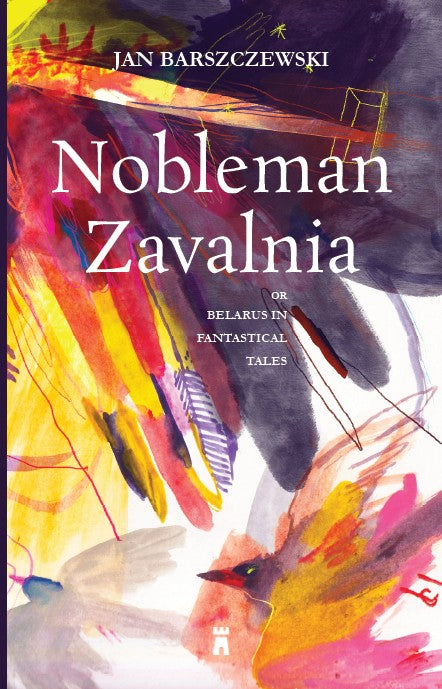
The Weeping Woman, Plačka in Belarusian, is a ghost from Jan Barszczewski's Nobleman Zavalnia, or Belarus in Fantastical Tales (1844–46): a beautiful woman in white with a black headscarf who sits weeping on stones, in ruined chapels and by forgotten graves across Belarus. Treasure hunters dig where she weeps and find only bones. The best-known reading of the book says she is Belarus itself.
Here is her tale, the village custom she grew from and the clue hidden in her coins. You can read it in full in the illustrated Nobleman Zavalnia, with full-colour pictures by Nasta Lee.
Who tells the tale
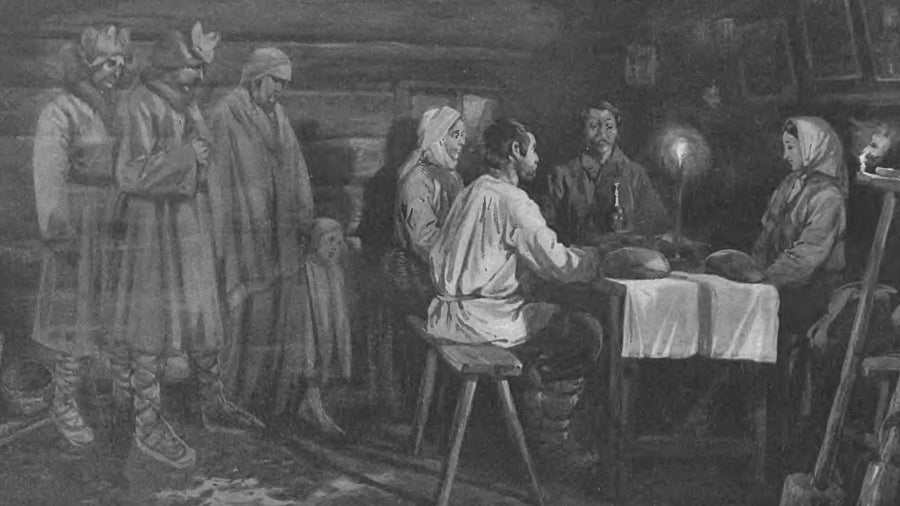
Nobleman Zavalnia is a frame tale set in the winter of 1816–17. Pan Zavalnia, a country nobleman on a lake near Polatsk in northern Belarus, gives travellers supper in exchange for stories. This one comes from Francisak, a blind wanderer who has travelled all over Belarus, who tells it as he heard it from people who saw her.
The tale of the Weeping Woman
She is strikingly beautiful, dressed in white as snow, with a black headpiece and a shawl, her face tanned by wind and sun and her eyes always wet with tears. She appears in abandoned houses, empty churches and ruined chapels. After sunset she sits on a stone and weeps that she has no one to confide the secret of her heart to.
In an empty house by the road from Polatsk, whose peasant family had been sent away by their masters, she appeared to a blind beggar, told him to pray because God is everywhere, threw a handful of silver coins into his hat and vanished. On one side the coins bore the images of kings. On the other was the Pahonia, a mounted knight with a raised sword.
Near the road to Viciebsk she wept on the steps of an abandoned chapel. The elders said she foretold war, plague or famine. The young men decided that treasure must be buried there. A crippled old man who had wandered the world warned them:
"Her tears and lamentations do not promise gold or silver. She weeps for the sviatynia — the sacred that you have forgotten."
They dug all night and found only rotten planks and skulls; the hill had once been a graveyard. At sunrise they saw her by the hazel bushes, and where she had stood hung a wasps' nest. As a joke they threw it through the old man's window, shouting that they had found treasure. Before his eyes it became gold, and the Weeping Woman told him to keep half and give half to the poor, for God helps her suffering children.
In Livonia, on the Baltic, she hung garlands on the ruins of an ancient castle and sobbed like a mother mourning her children. The lord of the estate had his men dig there for treasure, and they found a vault of skeletons still in shackles. He kept the shackles as antiques, though they were hardly different from the ones in use in his own day. The peasants reburied the bones under a great wooden cross. She knelt there with flowers for a few nights, and then was seen there no more.
Near Polatsk, by the Palata River, young men dug at night under the stone where she sat, hoping for the riches an army was said to have buried. They found armour on a skeleton. When they tried to take it, lightning split the sky and a giant clad in iron stood over them with his sword raised, cursing them for selling themselves for gold and defiling a hero's grave.
After that she was seen among the graves of Polatsk, at the door of the church of St Casimir and by the Dzvina. Few prayed when they heard her; most dreamed of treasure. To rich gentlemen out hunting she sometimes appears as an orphan girl in poor peasant dress, and none of them notices her. On Pachanouskaya Hill, people say, whoever drinks from her spring and recognises the orphan girl beside it will see all mysteries and all truths. People saw the girl and ignored her. When they came back, she and the spring were gone.
Pan Zavalnia hears a warning: people would sell for gold what their fathers valued more than life. Then he turns to his nephew Janka, a former pupil of the Jesuit school in Polatsk and the book's narrator:
"You, Janka," said my uncle, "are a learned man. Do you understand who the Weeping Woman is?"
"Miracles," I said, "must be understood with the heart, not with books."
Is the Weeping Woman a real Belarusian folk ghost?
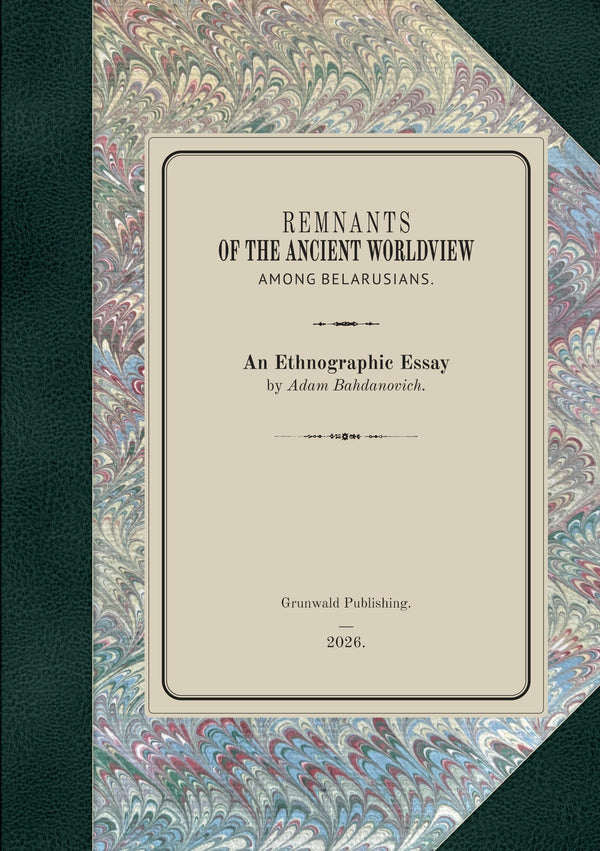
No independent folk record names a spirit called Plačka; a modern Belarusian encyclopedia of mythology builds its entry on her from Barszczewski's own text. But she is made of things every villager knew, and the best record of them is Adam Bahdanovich's Remnants of the Ancient Worldview among Belarusians: An Ethnographic Essay (1895), translated from the Russian, edited by Olya Ianovskaia.
The first is keening. Bahdanovich describes how, at the commemoration forty days after a death, the women keen over the grave: a tearful, improvised lament that is both grief and public praise of the dead. It mattered because "people who are alone in the world, for example, often grieve that there will be no one to weep over their grave." Keeners from outside the family, he adds, were dying out. The Weeping Woman is that keener for a whole country, the last mourner of a land whose own children have forgotten it. Belarusian families kept their own days for the dead, as our post on Dziady, the Belarusian day of the dead describes. Barszczewski's ghost keeps them for a nation.
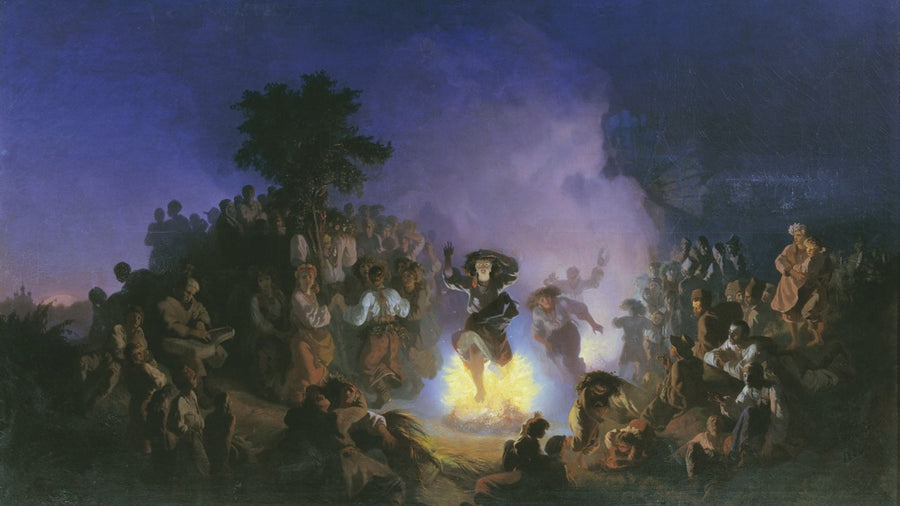
Bahdanovich also records the Plague Maiden, who flies over a doomed village before an epidemic, waving a black kerchief. A woman who appears from nowhere and is said to foretell plague would have chilled a village listener long before he thought of politics. And he records that at Kupalle, the midsummer night, buried treasure rises from the ground, showing itself as fire or glowing embers. That is why the young men dig where she weeps. Barszczewski's twist is what they find: not gold, but the forgotten dead.
Coins of a vanished state: the Pahonia
No folk source has these coins. The Pahonia was the coat of arms of the Grand Duchy of Lithuania, the state that included the Belarusian lands from the 14th century, joined Poland in 1569 to form the Polish-Lithuanian Commonwealth and disappeared in the partitions of 1772, 1793 and 1795, when the Belarusian lands went to Russia. By the 1840s even its last institutions were gone: the Jesuit academy in Polatsk where Barszczewski studied closed in 1820, the Uniate (Greek Catholic) Church, in which his father was a priest, was absorbed into Russian Orthodoxy in 1839, and the Grand Duchy's law code was abolished in 1840.
So the ghost gives alms in the money of a country that no longer exists. The coins are Barszczewski's own addition, and the most openly political sign in the tale. The other clues point the same way. St Casimir, at whose church door she sits, was the patron saint of the Grand Duchy. The shackles in the vault look just like those of the author's own day. And the first house she haunts is empty because a master sent its family away.
Who is the Weeping Woman? Belarus herself
Mikola Khaustovich, the Belarusian scholar who translated Zavalnia into Belarusian, read her as Belarus itself: the book's central hero, a mother mourning the children who forgot her, the land and not the Mother of God. The preface to our edition puts it simply: Belarus defeated, silenced, but alive.
The tale never says so. Zavalnia asks his question, Janka answers with the heart, and the talk moves on. That is how a writer speaks under censorship. In 1840 officials had been told to stop calling these provinces Belarusian. Barszczewski, writing in Polish in St Petersburg, put Białoruś on his title page and left a riddle that only readers who shared his memories could solve. When he died in 1851, his obituaries called him a Białorusin, a Belarusian.
The riddle kept working. Maksim Bahdanovich (1891–1917), the poet son of the author of Remnants, wrote "Pahonia", the poem of the mounted knight that became one of Belarus's unofficial anthems, and Khaustovich wonders whether the tale's iron giant inspired it. A Belarusian translation of Zavalnia was printed in 1990 in a run of nearly forty thousand copies.
Why Nobleman Zavalnia matters
The Weeping Woman haunts other tales too: on the night the White Magpie's messenger comes to buy a local lord, a woman is heard weeping in the cemetery. Barszczewski's ghosts mourn where Gogol's devils joke, as our comparison with Gogol's Dikanka shows. These are ghost stories told as true, built from real village belief, that carried a lost country past the censor. Ours is the first complete English translation, and the premium edition is a hardcover illustrated in full colour by Nasta Lee.