Rusalki: Slavic Water Maidens in Belarusian Belief
Rusalki swing in the birches and tickle passers-by to death; the water spirit drags bathers into the whirlpool. What Belarusian villagers believed about them, and where Barszczewski set the rusalki in Nobleman Zavalnia.
In this post
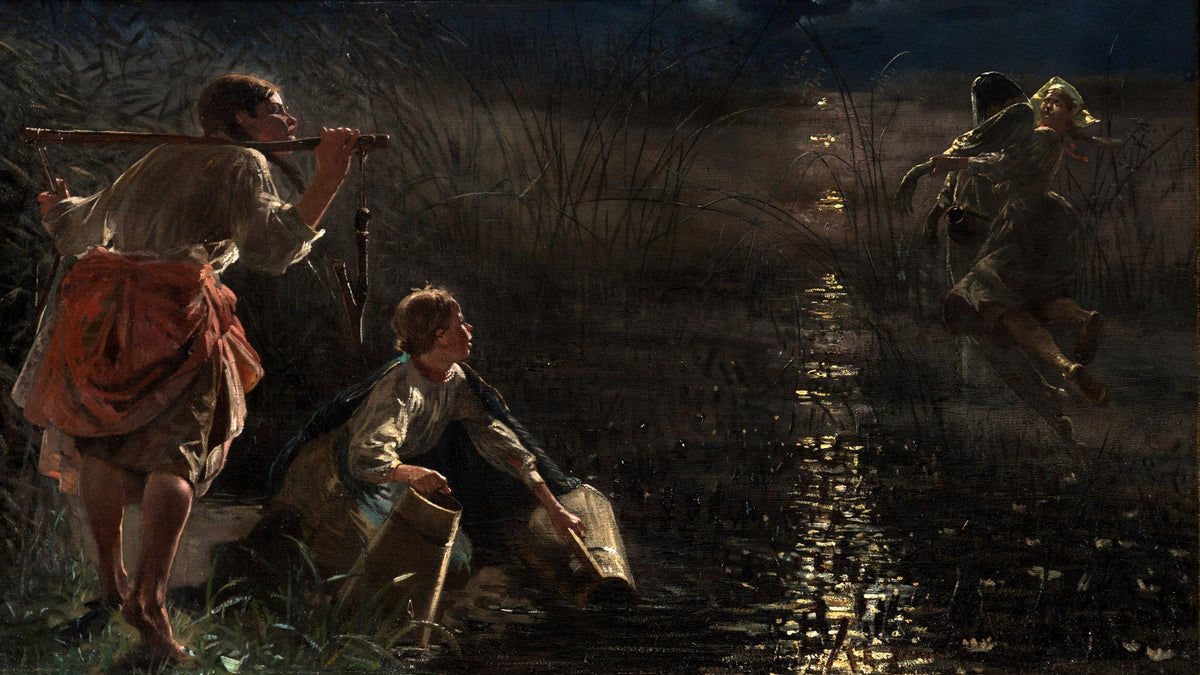
A rusalka (plural rusalki) is a water maiden of Slavic folklore: a beautiful young woman with long, loose hair who lives in rivers and lakes and comes out in early summer to swing in the trees. She is no friendly mermaid. Belarusian villagers believed rusalki lured passers-by close and tickled them to death, or dragged bathers to the bottom and drowned them.
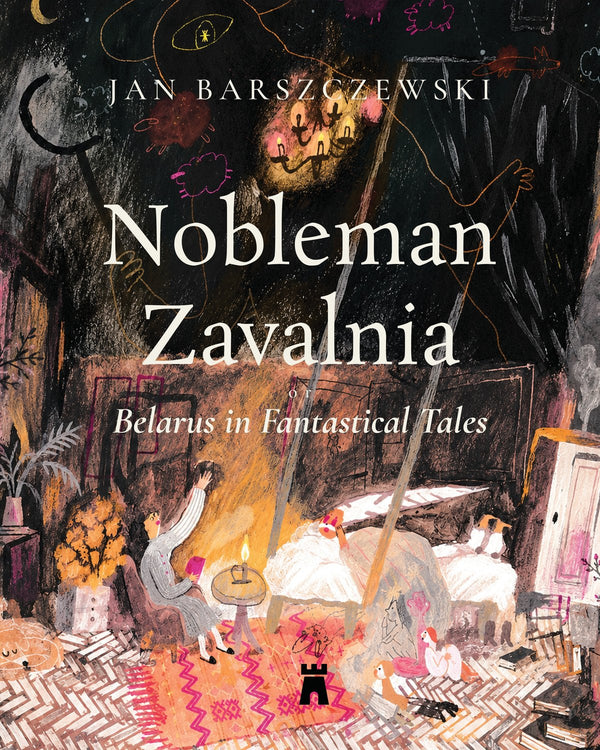
That is how they appear in Adam Bahdanovich's Remnants of the Ancient Worldview among Belarusians (1895), his record of Belarusian village belief, now in its first English translation. Half a century earlier, Jan Barszczewski's tales of northern Belarus, Nobleman Zavalnia (1846), set the same water maidens at a crossroads in one of the strangest stories in the book. For the other spirits of water, forest and home, see our field guide to Slavic folklore creatures.
What is a rusalka in Slavic folklore?
Bahdanovich describes the rusalki as creatures of both water and land. They live in the water from autumn until Rusalka Week. Then they come out and settle in the branches of trees, especially birches:
They swing on the pliant branches, calling to passersby: “Man! Man! Come and swing with us!” And if anyone is foolish enough to come close, they tickle him to death.
Villagers pictured them as beautiful women with long, loose hair. Some believed that the souls of children who died before baptism became rusalki. The notes to the English Nobleman Zavalnia give the wider Slavic picture: a rusalka is usually the spirit of a young woman who died before her time or by violence, and she haunts rivers, lakes and forests, singing, dancing and enticing men, but also bringing illness and death.
When is Rusalka Week?
Rusalka Week is the first week after Trinity, the church feast seven weeks after Easter, so it falls in late spring or early summer. Until then the rusalki are still in the water, and bathing is dangerous: the bather may fall ill, or the rusalki may drag him into the depths of the river and drown him.
The week also governed the holy springs. Belarusians made pilgrimages to famous springs from the first thunder of spring, and spring water was prized for healing. But until Rusalka Week the water was taken only for drinking. After it, people bathed in the springs where they could, and watered and bathed their horses there too, to cure illness or ward it off.
The water spirit: vodzianik or vodianoi
The rusalki share the water with a more dangerous master, the water spirit. Bahdanovich calls him the vodzianik (the Russian vodianoi); in Barszczewski's tales he is the vadzianik. He lives in living water, water that has only just broken out of the ground. Every vir, a whirlpool or a spring in a river or lake, has its own. He also lives in bottomless springs, in deep rivers and lakes, and wherever the water does not freeze in winter, because his breath melts the ice.
He takes lives. People who drowned by accident were thought of as his prey, pulled down to him on the bottom. Bahdanovich heard of many places in Belarus where a lake had once held a water spirit so greedy that he kept dragging people into the vir. The villagers would turn to a woman healer, a znakharka. She found the vir, dived boldly to the bottom, plugged its mouth with pea stalks and weighed it down with a stone. Little by little the lake dried up, and the water spirit moved off somewhere else.
Millers had to live with him. A watermill miller kept the water spirit content so that the mill never stood idle for lack of water: at the first frost he lowered a piece of salt pork under the wheel, and if he forgot, the spirit licked the grease off the axles. Ordinary households kept the drinking-water barrel covered, or something unholy might get in. Like the leshy, the forest spirit, the water spirit can do evil but need not; in that he differs from the devil.
Rusalki in Nobleman Zavalnia
Barszczewski grew up near Polatsk in northern Belarus. Bahdanovich, writing chiefly from central Belarus half a century later, never mentions him. Yet their rusalki are the same. In the sketch of his home country at the front of the illustrated Nobleman Zavalnia, Barszczewski writes:
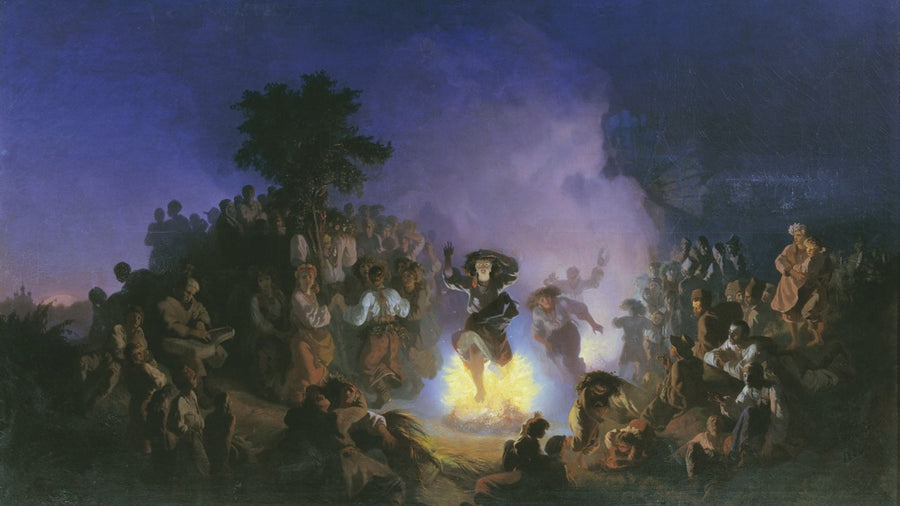
When the rye blooms in the field, rusalkas swing on birch trees, their long hair flowing in the wind as they sing.
Their laughter, he adds, echoes deep in the forests and startles the mushroom and berry pickers. The birches, the loose hair and the early-summer season are Bahdanovich's Rusalka Week, recorded independently. In another tale a rusalka with dew in her hair leads away Tamash, a peasant healer whom no demon could deceive, and he never returns.
The jabber-weed tale: the road of the rusalki
The rusalki's great scene comes in "Jabber-Weed", one of the stories told at the manor of Pan Zavalnia, a country nobleman (Pan is a gentleman's title, roughly "Mr") who shelters snowbound travellers in the winter of 1816–17 and asks each for a tale. This one is told on New Year's Eve by Basil, a Roma horse dealer.
A young man named Adolf comes to Shylka, a wise Roma healer and fortune-teller, to learn his future, Alma's future and what Alma thinks of him. Shylka warns him not to ask. When Adolf insists, Shylka tells him of jabber-weed, an underwater herb that reveals the future when touched to the temple. It shines like a star among sharp stones at the bottom of a lake, in the dwelling of a spirit called Pharon, who dozes beside it in the noon heat and hides it under a tangle of weed at sunset.
At the hottest hour of a calm day, with a piece of Shylka's bark in his mouth to keep him from harm, Adolf walks into the lake and along the bottom, past strange translucent creatures, and plucks a leaf without waking the spirit. On the far shore he touches it to his temple, and the land changes before his eyes. The stone church on the hill is a ruin. The village is gone except for two old pear trees. The fields are overgrown with wild grass. No one he meets has heard of his home. When he finds Shylka again, the seer's hair has turned white: more than ten years have passed, and Adolf's friends think he is dead.
Shylka gives him directions. He will come to three roads. The broad roads to the left and right look inviting; between them runs a narrow, grassy path through rocky fields and dark forests, and that is the one he must take. The right-hand road leads to golden castles where skeletons dance at midnight. The left-hand road runs through lovely meadows and groves, and there the rusalki play, with wreaths of cornflowers on their heads and long hair streaming down their shoulders. Some are merry and frivolous:
They sing and dance, beguile and amuse with playful talk, luring the wanderer into the darkness of the forest. Once lost there, the unfortunate never finds his way back.
Others are pensive and sad, and their songs pierce the heart like an arrow; they drive the listener to despair and then vanish. Adolf takes the narrow path. At dusk a tall woman in white steps out of a birch grove, her face streaming with tears, a sword in her hand. Then the rooster crows at midnight, the New Year arrives, and the story breaks off. The book's note says only that its ending is missing.
What the jabber-weed tale hides
The Belarusian scholar Mikola Khaustovich, who translated the book into Belarusian, takes Alma, a name Barszczewski used more than once, for alma mater: the Jesuit academy in Polatsk where Barszczewski studied, closed when the Jesuits were expelled from the Russian Empire in 1820; Polatsk itself; and beyond it, Belarus.
Read that way, to see the future of this land is to see it emptied: the church in ruins, the village gone, the fields unploughed. The man who looks becomes an exile who cannot find his way home, and Barszczewski was writing in St Petersburg, far from Polatsk. The rusalki stand on the pleasant, easy road, the one from which no wanderer comes back. Only the hard, overgrown path leads home. And the weeping woman with the sword recalls another of his figures, the Weeping Woman, Belarus's mourning ghost.
The rusalki of the tale work exactly as Bahdanovich's do: they call, they charm, and whoever comes close is lost. Barszczewski only moved them from the birches to the crossroads of a country's future.