An 1895 Ethnography of Belarusian Folk Belief, in English at Last
Adam Bahdanovich's Remnants of the Ancient Worldview among Belarusians (1895) recorded what the Belarusian village believed, from the house spirit behind the stove to Kaliady, Kupalle and Dziady. Here is what is in it, and who wrote it.
In this post
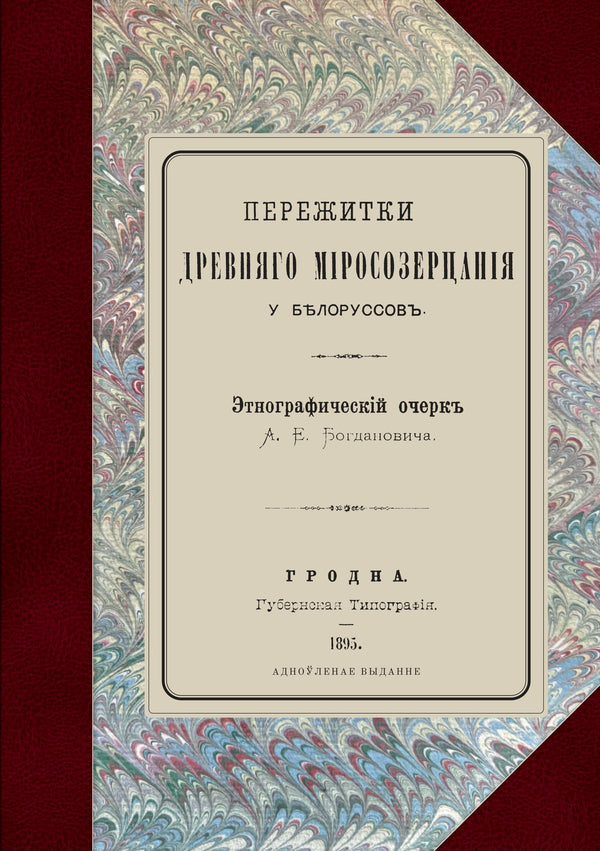
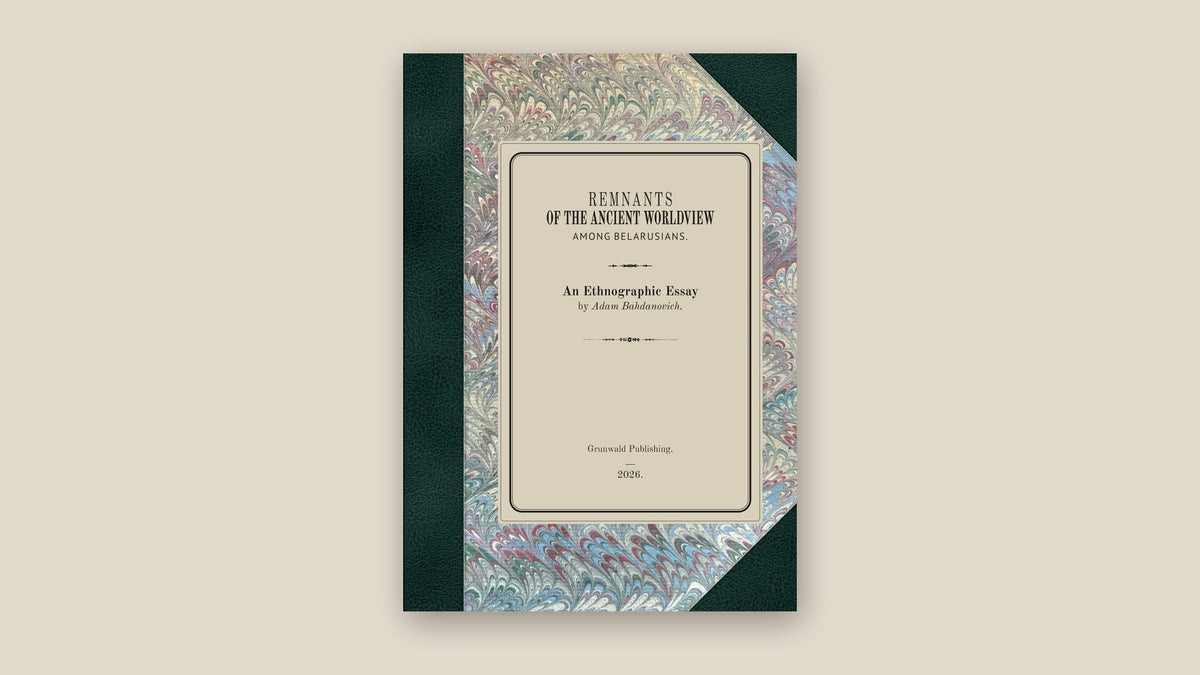
Remnants of the Ancient Worldview among Belarusians is Adam Bahdanovich's record of what the Belarusian village believed: the house spirit behind the stove, the master of the forest, the water maidens, the sorcerers, witches and village healers, the charms they whispered, and the old holy days of Kaliady, Kupalle and Dziady. Printed in Hrodna in 1895, it was one of the first attempts to set out the folk beliefs of the Belarusians as a single system. Until this edition, it had never appeared in English.
The first English translation of Remnants is published on 31 October 2026, in paperback and as an EPUB. Bahdanovich was an ethnographer and the father of the poet Maksim Bahdanovich, and he wrote down nearly everything in the book himself, in the villages of central Belarus.

What the Belarusian village believed
Bahdanovich asked a simple question: what was left, in his own day, of the beliefs Belarusians had held before Christianity? His answer runs through eight chapters. Fire, water, stones and trees are still treated as living powers. The souls of the dead come home to eat. Spirits keep the house, the barn, the forest and the river. The sun is greeted with songs at midwinter and midsummer. And everywhere there is the unholy: the folk name for devils and evil spirits of every kind, and for the power that witches and sorcerers draw on.

The house spirit behind the stove
Every peasant house had its khatnik, the house spirit, the Belarusian cousin of the Russian domovoi. Those who claimed to have seen him describe a little old man with a grey beard and long grey hair, in a linen caftan or a white shirt. He sleeps on or under the stove, which is why he is also called the podpechnik, "the one under the stove". He has all the qualities of a thrifty householder: he gets up early and gives the rooster a push, so that it flaps its wings, crows and wakes the household for work.
The master of the forest
The leshy, or lesovik, rules the forest and everything in it. Bahdanovich calls him "the most majestic image the Belarusian imagination has created". He is as tall as the trees he walks among, and grows or shrinks to match them. In a storm he tears oaks up by the roots. He lives in the matochnik, the heart of the primeval forest, ringed by fallen timber and by bogs that do not freeze even in the hardest winters, where the large beasts go to die. There is more on him in our post on the leshy, the forest spirit.
The water maidens
Rusalki live in the water from autumn until Rusalka Week, the first week after Trinity. Then they come out and settle in the branches of trees, especially birches, swinging on them and calling to passers-by: "Man! Man! Come and swing with us!" Whoever is foolish enough to come close is tickled to death. Until Rusalka Week, bathing is dangerous. See Rusalki: Slavic water maidens in Belarusian belief.
Sorcerers, witches and healers
A whole chapter goes to the people villagers believed were in league with the unholy: the charovnik or sorcerer, the vedzma and vedzmak, a female and a male witch, the znakhar or healer, and the vaukalak, the werewolf. They were not equal. To call someone a witch or a werewolf was an insult. A healer, who mostly used that knowledge to help the neighbours, was respected: "To be known as a healer is even an honor." Read more in Slavic witches, sorcerers and healers.
The charms they whispered
Charms, the formulas healers whispered over the sick and over cattle, were the hardest thing to collect. Families kept them as their own property and passed them down the generations. When Bahdanovich asked healers he knew for their charms, they almost always refused, and assured him they knew nothing beyond how to cross themselves. That secrecy, he argued, is exactly why charms keep the oldest layer of belief in its purest form. Most of the charms in the book come from a single family of healers, and they are printed in full, among them this one, against bleeding, from the Barysau district:
Close up, you veins of blood! Stop, do not flow, red blood!
The old holy days
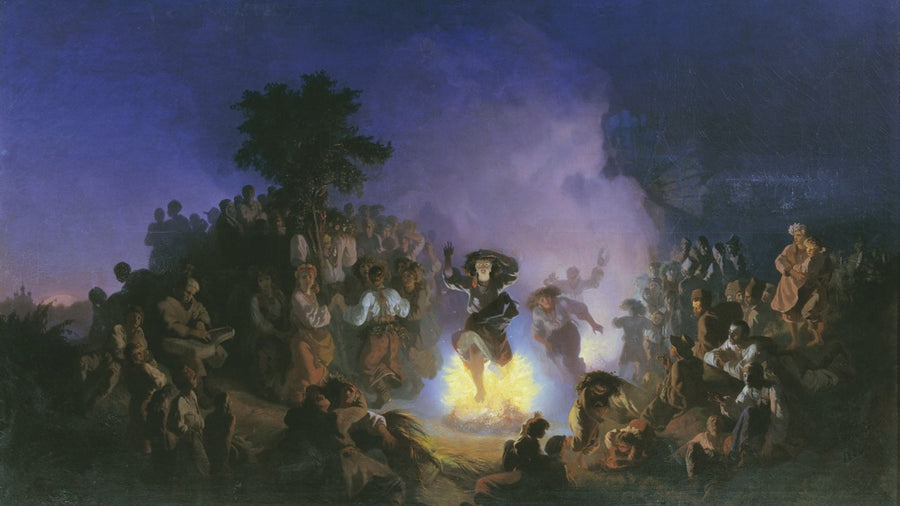
The village year turned on festivals far older than the church calendar they were fitted into. Kaliady, at midwinter, marked the beginning of the year: the carollers went from house to house, often leading a goat, and, as Bahdanovich notes, there were no Kaliady without sausage. On Kupalle night, at midsummer, young men and girls leapt over the bonfires, and the fern bloomed for a single instant, its flowers burning like tiny sparks. Whoever got hold of one would know where treasure lay. Read more about Kupala Night.
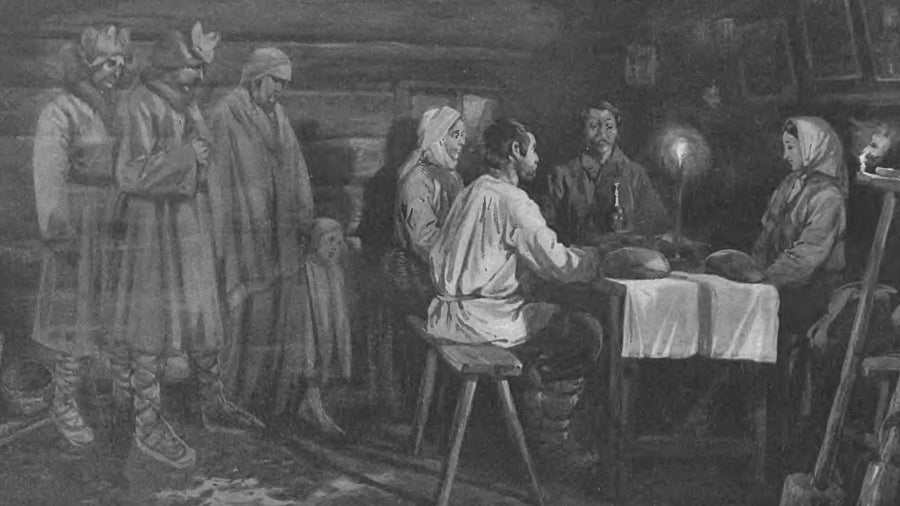
And at Dziady, several times a year, the family laid a memorial supper and invited its dead to share it. The house was always cleaned beforehand, "as if expecting dear guests". The master of the house stepped outside the door to call the ancestors in, and after every spoonful the living laid down their spoons so that the dead could eat. Our post on Dziady, when the dead come home to supper tells the whole rite.

Who was Adam Bahdanovich?
Adam Bahdanovich (1862–1940) is remembered as an ethnographer and historian. A native of Belarus, he had once lived through the very customs he describes. Later his official duties took him to live for long periods in different parts of Belarus, in close contact with the people, and he added to his notes as he went. He gathered most of his material in the Barysau, Ihumen, Minsk, Slutsk and Navahrudak districts of Minsk province, around Sianno and Orsha in Mahilyow province, and in the Lepel district of Vitsebsk province.
A first version of the essay appeared in 1894 in the St Petersburg journal Nauchnoe Obozrenie (Scientific Review). The expanded book was printed by the provincial press in Hrodna the following year, under the Russian form of his name, A. E. Bogdanovich, the form still found in library catalogues.
He is best known as the father of Maksim Bahdanovich (1891–1917), one of the great poets of Belarusian literature. The family was living in Hrodna in those years, and Maksim was a small boy when Remnants came out.
About this translation
This is the first English translation of Remnants, and it is complete: every paragraph, footnote, charm, song and place attribution of the 1895 edition is here, in the author's order. The prose has been revised to read as present-day English, while his meaning, his examples and his terms are kept. The songs and charms are given line for line, with their repetitions and formulas, and with no rhyme added where the originals have none. Place names are in their Belarusian forms, folk terms are explained where they first appear, editor's notes identify the people and books he cites, and his own subject index is translated too.
Bahdanovich wrote as an anthropologist of the 1890s and a subject of the Russian Empire, and his words and judgments are kept as he wrote them, because they belong to the period and to his argument. What he recorded is the reason to read him: a village world of spirits, charms and holy days, written down by someone who knew it from the inside.
Three editions of one book
- The English translation, translated from the Russian and edited by Olya Ianovskaia: paperback and EPUB.
- The restored edition: the original 1895 Russian text, newly typeset, in paperback and as an EPUB.
- The 1895 facsimile: a page-for-page reproduction of the original Hrodna printing, in paperback.
The songs and charms in their original Belarusian, which Bahdanovich printed in Russian letters, are in the restored and facsimile editions.